When considering the cost of furnishing an entire home, it's surprisingly difficult to establish what constitutes a reasonable investment.
Most of us furnish our homes gradually, collecting pieces over many years. A beautiful antique discovered on our travels, a sofa purchased when we moved house, artwork acquired because it meant something to us. Rarely do we consider the collective value of everything we've accumulated, either financially or aesthetically. When designing a home in its entirety, that changes.
At Usher and Co, one of our earliest conversations with clients is about establishing a level of investment they're comfortable with. Interestingly, this can be just as challenging for clients with considerable financial means as it is for anyone working within a defined budget.
Having the means to invest significantly in a home doesn't necessarily mean wanting to spend without consideration. Most people, regardless of their financial circumstances, have a figure in mind that feels appropriate to them. The difficulty arises when that figure hasn't yet been established, or when clients are understandably reluctant to share it.
From a designer's perspective, understanding a client's expectations is essential. There is an enormous breadth of choice within the luxury interiors market, and while everything we specify at Usher and Co must meet our standards for quality and craftsmanship, there can still be considerable differences in price.
We are guided first by quality, rather than cost alone. But we also recognise that furnishing an entire home represents a substantial financial commitment, and our responsibility is to ensure that the design reflects both the client's aspirations and their expectations of investment.
Beyond the obvious pieces:
It's relatively straightforward to imagine the cost of the principal pieces. A sofa, a pair of armchairs, a dining table and ten chairs, perhaps a beautifully made bed. What is far less obvious is the collective cost of everything that makes those rooms feel complete. The automated window treatments, bespoke joinery, decorative lighting, occasional furniture, textiles and artwork. The objects collected through a lifetime of travel, the pieces commissioned specifically for a particular space and the many smaller details that bring warmth, character and individuality to a home.
These elements are often overlooked when clients first contemplate the cost of furnishing a property. Yet they contribute enormously to the difference between a room containing beautiful furniture and a home that feels genuinely considered. We can share examples of previous projects, discuss the cost of individual pieces and explain what different levels of investment might achieve. But those figures are only ever a guide.
One client's idea of an appropriate investment may be entirely different from another's, even when their properties and financial circumstances are comparable. We've experienced situations where clients have subsequently expressed a preference for particular designers, makers or furniture brands at a considerably higher price point than we'd initially understood.
Neither approach is inherently right or wrong. The important thing is that we understand those expectations from the beginning. For that reason, we encourage clients to think carefully and openly about what they feel comfortable investing in their home.
The complexity behind procurement:
For a substantial residential project, procurement can involve hundreds, potentially thousands, of individual items and purchase orders. Each requires careful consideration, specification, coordination and management, often across an extensive network of manufacturers and specialist suppliers. Long before an order is placed, there is a detailed process of research, sampling and evaluation.
We consider materials in the context of the entire design, examining how they relate to one another aesthetically, how they will perform in their intended setting and how they are likely to age over time. A beautiful natural stone may develop a patina that one client finds utterly charming, while another would prefer a surface that retains a more consistent appearance.
A fabric might be visually perfect but unsuitable for the demands of everyday family life. We consider durability, maintenance, fire safety requirements, slip resistance and the practical implications of living with particular materials. The presence of children or pets, how frequently a room is used and even the way a client feels about natural wear all influence our recommendations.
These considerations are balanced against the overall financial investment. Some pieces deserve to command a greater proportion of the budget because of their scale, craftsmanship, prominence or importance within a room. Others can be selected at more modest price points without compromising the integrity of the wider design. Knowing where to invest, and where a less expensive alternative will serve equally well, allows us to make the client's budget work to its greatest effect.
Managing hundreds of moving parts:
Once specifications are agreed, an entirely different layer of complexity begins. Every supplier has its own manufacturing schedules, payment requirements and lead times. Some pieces may be readily available, while others require months of specialist production.
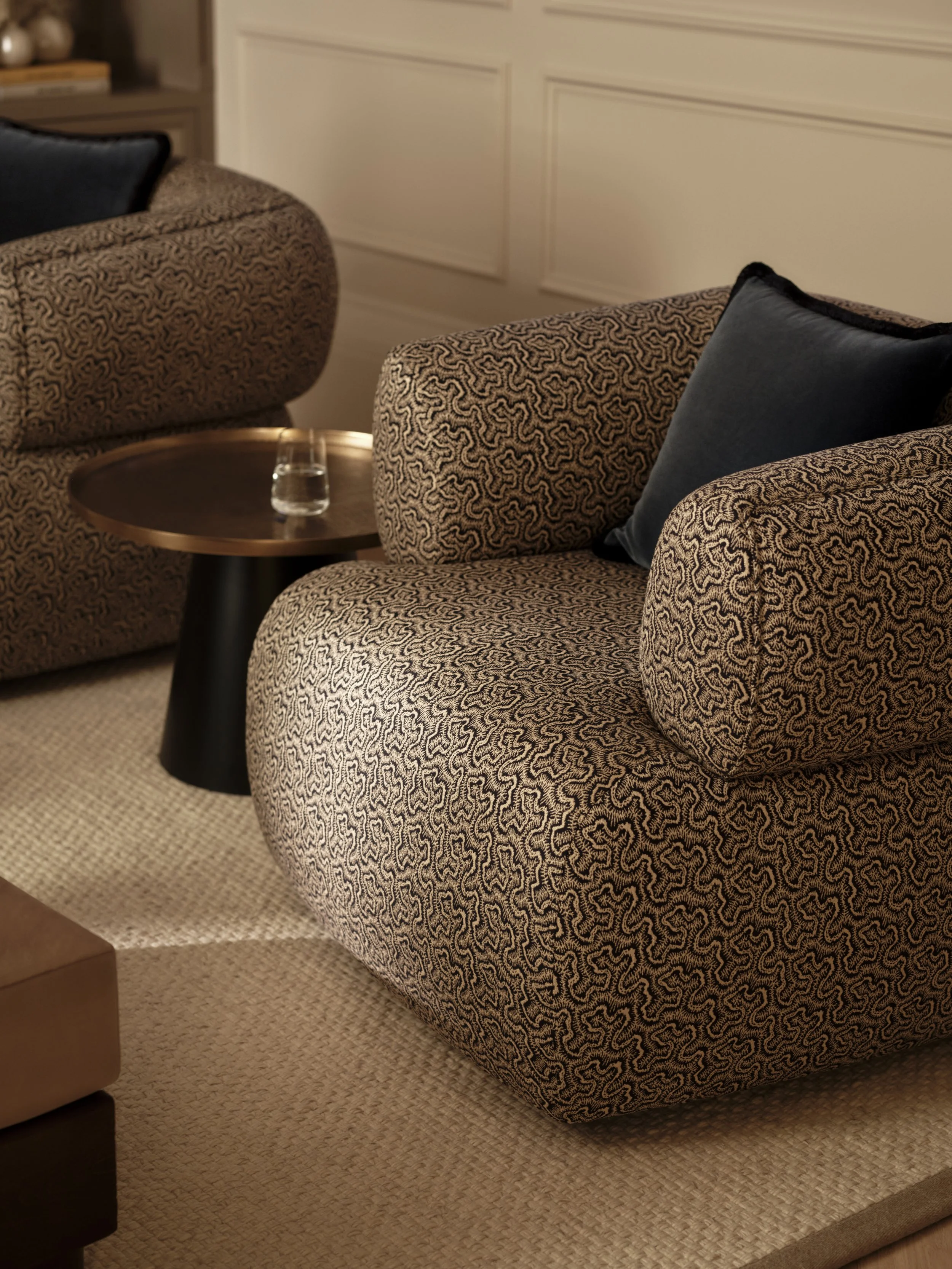
We must consider where items are manufactured, whether international shipping or import duties apply and how seasonal factory closures, particularly in countries such as Italy, might affect delivery dates. Orders must be carefully sequenced.
Typically, we prioritise items with the longest lead times, often substantial upholstered pieces, bespoke furniture and specialist cabinetry. At the same time, we must coordinate the many smaller elements that complete a room, right down to the final cushion trim or decorative accessory. The objective is to bring everything together for installation while avoiding unnecessary storage costs and allowing a sensible margin for unforeseen delays.
And there will occasionally be unforeseen delays. Products can be discontinued, manufacturing schedules can change and international shipping can be disrupted by circumstances entirely outside our control. Even with meticulous planning, there are occasions when something doesn't arrive when expected or a product fails to meet the required standard.
We work with specialist storage and logistics companies that can receive goods, inspect deliveries, identify damage or imperfections and arrange appropriate insurance cover for items held on our clients' behalf. Identifying problems early gives us the best opportunity to address them before installation.
Where possible, we manage these issues directly with suppliers and logistics partners, often without needing to trouble our clients with every complication. If a more significant problem arises, our priority is to minimise disruption. We work closely with manufacturers, transport companies and other specialists to explore solutions, expedite deliveries where possible and, when appropriate, arrange temporary alternatives.
What happens when a supplier encounters financial difficulties?
A substantial residential project may involve hundreds of individual specifications, from architectural finishes and specialist flooring to lighting, furniture, window treatments and bespoke commissions. Behind those specifications are numerous independent manufacturers, craftspeople and suppliers, each operating with their own lead times, payment terms and commercial circumstances.
The financial pressures affecting the wider economy do not impact every business equally. Some suppliers may be thriving, while others face challenges that aren't immediately apparent to those purchasing from them. At Usher and Co, we take our responsibility to clients seriously, particularly when recommending businesses with whom they may be committing substantial sums of money.
We have longstanding relationships with many of our suppliers and place considerable value on the knowledge, craftsmanship and expertise they bring to our projects. We also recognise that familiarity and reputation alone cannot provide an absolute guarantee of financial security.
Where appropriate, particularly for higher value purchases, we may undertake additional due diligence, including company credit checks. This is also something clients can request when considering a significant financial commitment.
We may discuss payment terms with suppliers, explore whether payments can be staged and consider the potential exposure associated with substantial deposits or lengthy manufacturing periods.
Our relationships across the interiors industry can also provide valuable insight. Occasionally, concerns about a supplier's circumstances may come to our attention, and where we become aware of information that could materially affect a client's purchasing decision, we believe it is important to share those concerns. There are, however, limits to what any design studio can reasonably know or control.
We do not own or directly employ the independent businesses responsible for manufacturing and supplying the products we specify. Nor can we guarantee their future financial stability. Even a business with an established reputation and a healthy trading history can encounter unforeseen difficulties.
What we can do is exercise sound professional judgement, undertake proportionate due diligence and ensure our clients are informed about the arrangements under which their purchases are made.
Why we act as buying agent:
At Usher and Co, our decision to act as buying agent for our clients is a deliberate one, rooted in both our approach to design and our responsibility to operate a financially sound business. A traditional retailer purchases products, holds stock and offers those products for sale. Naturally, there is a commercial incentive to sell the items in which the business has already invested.
For an independent interior design studio, we believe that approach would introduce an unnecessary limitation to the creative process. If we were purchasing furniture and accessories in anticipation of selling them to future clients, our design decisions could become influenced by the products we already owned.
We believe the strongest interiors emerge when creativity is given the freedom to explore different possibilities, without being constrained by a predetermined collection of products. Our approach allows us to work with an extensive network of manufacturers, craftspeople, artists and specialist suppliers, selecting each element according to the needs of the individual project.
Once a design has been developed, we present our recommendations, establish the associated costs and seek our client's approval before proceeding with purchases on their behalf. There is also an important commercial consideration behind our agency model.
A substantial residential project can involve hundreds of suppliers, and across multiple projects, the number of independent businesses with which we work is considerable. For a specialist design studio to assume the full contractual responsibility associated with every supplier, across every project, would introduce a level of financial exposure that we believe requires careful consideration. The financial health of a design studio matters to its clients.
They are placing considerable trust in us, committing to a long-term professional relationship and relying on our ability to manage their project with consistency and care. Our agency structure allows us to maintain a clear distinction between the professional services we provide and the products purchased from independent suppliers. It also enables us to manage our own commercial exposure responsibly, while helping clients understand the purchasing arrangements and associated risks.
The importance of experience and relationships:
Many of our suppliers are businesses with whom we have developed relationships over numerous years and projects. We understand their craftsmanship, their standards and, importantly, how they respond when something doesn't go according to plan. That experience is enormously valuable.
We know that even the best manufacturers occasionally encounter difficulties. What matters is their willingness to take responsibility, communicate openly and work constructively towards a solution. Our longstanding relationships allow us to approach procurement with confidence, while recognising that no supplier or process is entirely without risk.
Ultimately, the work involved in furnishing a significant home extends far beyond placing orders. It requires creative judgement, technical understanding, financial consideration, careful planning and an enormous amount of coordination. And while much of that work takes place behind the scenes, every decision contributes to the experience of bringing a client's home together.
We believe that an investment of this significance deserves nothing less than careful consideration, honest communication and the professional experience to navigate the complexities along the way.